




Drones have already proven their worth. The next question isn’t whether they work — it’s why so few organizations are capturing their full potential. The answer will reshape entire industries. Imagine you could see your …

0
Drones have already proven their worth. The next question isn’t whether they work — it’s why so few organizations are capturing their full potential. The answer will reshape entire industries.
Imagine you could see your entire operation from above, in real time, at any moment. Every pipeline, every tower, every acre of crop, every perimeter fence — surveyed, analysed, and reported before your morning coffee. No crew deployed. No risk taken. No data lost in a spreadsheet.
That future isn’t science fiction. For a growing number of forward-looking organizations, it’s Tuesday.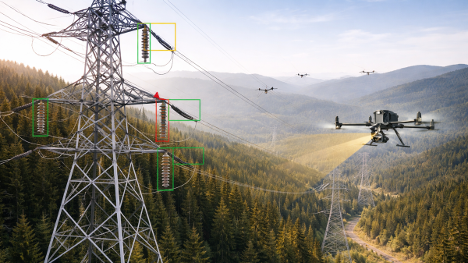
Drones have quietly crossed a threshold. The technology works. The ROI is documented. The industries convinced are no longer a handful of early adopters — they span energy, infrastructure, telecoms, agriculture, public safety, and defence. And yet most enterprises are still using drones the way someone in 1995 used the internet: for one or two specific things, disconnected from everything else.
That gap — between what drones can already do and what most organizations are actually doing with them — is the most interesting business opportunity in industrial technology right now.
“The question has shifted. It’s no longer ‘do drones deliver value?’ It’s ‘why aren’t we scaling faster?’”
The proof is already in
Let’s be clear about one thing: drones work. The ROI case is not theoretical. Energy companies are cutting inspection costs by up to 70% compared to manual crews. Utilities that once spent days deploying teams across high-voltage transmission lines now complete the same surveys in hours. Agricultural operators using drone-based monitoring report measurable improvements in yield decisions. Security providers are replacing static camera networks with dynamic aerial coverage that responds to events in real time.
- 70% – Cost reduction vs. manual inspection crews
- $55B – Projected global commercial drone market by 2030
- Days → Hours – Time saved on critical infrastructure surveys
Beyond visual line of sight (BVLOS) regulations are advancing across the US, Europe, and the Middle East. AI-powered analytics can now process drone imagery faster than any human analyst. Hardware costs have dropped significantly. The old objections — cost, safety, regulatory friction — are falling away one by one.
The market ahead is enormous. Analysts project the commercial drone sector to reach $55 billion globally by 2030, driven by enterprise adoption across exactly the verticals where drones have already proven their value. That growth isn’t coming from hobbyists. It’s coming from organizations who finally have the tools to deploy drones not as experiments, but as operational infrastructure.
So why isn’t everyone doing this at scale?
Here’s the paradox. Despite clear ROI and maturing technology, most enterprise drone deployments plateau. A pilot project succeeds, budget is approved, a fleet grows — and then the complexity hits.
Data from flights lives in one system. The asset management platform lives in another. The compliance records are in a folder somewhere. When a new drone model is added, it doesn’t integrate with the existing workflow. When a pilot leaves, half the operational knowledge walks out with them.
The drones are fine. The problem is the infrastructure around them — or the lack of it.
THE FOUR SCALING BARRIERS EVERY ENTERPRISE HITS
- Data silos — flight data never connects to business systems
- Fragmented fleets — multiple platforms with no unified management layer
- Manual operations — growth requires proportionally more pilots
- Compliance gaps — governance doesn’t scale with deployment volume
This is a structural problem, not a technology problem. And it’s one that’s been solved before.
The lesson from the last great enterprise transformation
In the early 1990s, enterprises faced a strikingly similar challenge. Finance, logistics, manufacturing, and HR each ran on separate systems. Data was siloed. Getting a complete picture required manual effort. Scaling operations meant adding headcount to manage the coordination overhead.
Then ERP arrived. Enterprise Resource Planning didn’t replace any of those individual systems — it connected them. It created a single operational layer that unified data, standardised workflows, and made it possible to scale without proportionally scaling complexity.
The organizations that adopted ERP early didn’t just become more efficient. They became structurally different — more agile, more data-driven, more capable of responding to change. Those that resisted spent the next decade trying to catch up.
Drone operations are at that same inflection point today. The hardware is ready. The data is being generated. What’s missing is the layer that connects it all.
“Every major enterprise technology wave has had the same shape: capable tools, fragmented adoption, then a unifying platform that unlocks the real value. Drones are next.”
The visionaries building that layer
This is where FlightOps enters the story — not as another drone manufacturer or flight management app, but as something more fundamental: an enterprise integration platform for robotic operations.
The insight behind FlightOps is deceptively simple. Drones don’t fail to deliver value because of what they are. They fail to scale because of how they connect — to other systems, to enterprise workflows, to the people who need to act on the data they collect. FlightOps is designed to solve that connection problem.
Think of it as the operating system between your drone fleet and your enterprise. Mission planning, fleet management, data pipelines, compliance frameworks, and API integrations with existing business systems — unified in a single platform that works across hardware vendors, across geographies, and across use cases.
WHAT THE FLIGHTOPS LAYER ENABLES
- Centralized data — flight intelligence flows directly into business systems
- Hardware agnostic — one platform manages any drone fleet, any vendor
- Automated workflows — missions execute without manual administration
- Built-in compliance — governance scales automatically with operations
- Open APIs — drones become a native part of enterprise architecture
The result is that drone operations stop being a specialist function and become infrastructure — as embedded and dependable as any other enterprise system.
What the market looks like from here
The organizations that will win the next decade won’t simply be the ones that own more drones. They’ll be the ones that have figured out how to extract consistent, scalable value from aerial data — and connect that value directly to operational decisions.
In energy, that means maintenance schedules driven by real-time inspection data rather than fixed calendars. In agriculture, it means yield interventions triggered automatically when drone imagery detects stress patterns. In security, it means aerial response that integrates with access control and incident management systems. In logistics, it means last-mile delivery coordinated within a broader supply chain platform.
The market for this kind of integrated aerial intelligence is not a niche. It is the direction the entire sector is moving. And the window for visionary organizations to establish position — in both deployment and platform development — is open right now.
Drones aren’t the future anymore. They’re the present. The transformation that’s coming is in how we connect them to everything else — and the companies building that connective tissue today will define the industrial landscape of tomorrow.
FlightOps develops enterprise drone integration platforms, connecting aerial robotic operations to the workflows, data systems, and business intelligence that organizations depend on. Https://flightops.io